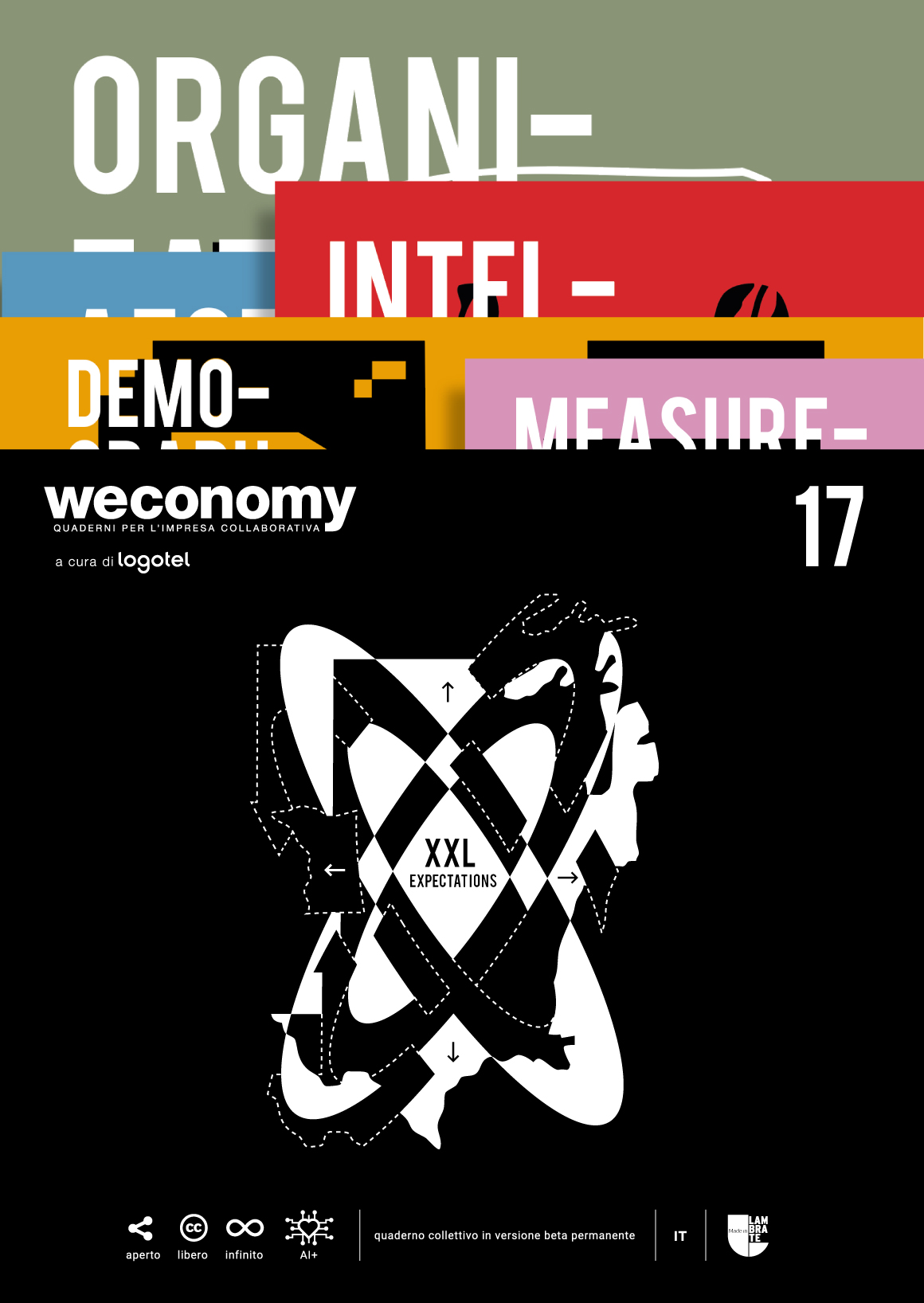
If you’re here, it’s because you’re holding Weconomy’s XL Expectations notebook.
Hands with different stories, yet one thing in common: the need to experiment – and to test ourselves – without waiting. That is what pushed us, at Logotel, to start asking questions: to bring together multiple perspectives, practices, sensibilities, and intelligences, and to try to understand why it feels as though we have stopped encountering the future – starting, however, from the present we are immersed in.
It seems that without a shared idea of the future, we no longer know how to act. Even the simplest decisions become difficult. It is almost as if, without engaging with the future, there were no present at all. And yet the future remains confined to theoretical plans, while we are left with our stubborn, unyielding present – many plans, many projects, as many as the possibilities that might one day take shape.
Let’s say it clearly: there is something deeply true – and healthy – in the idea that the future, in a sense, pulls the present toward it. We cannot live tethered to “the peg of the instant,” as the young Nietzsche wrote; we are made to look ahead, not down at the ground.
We are people, teams, organizations, companies, and supply chains operating in a FLUX reality – fast, fluid, uncharted, and experimental – as Timothy Tiryaki argues in the booklet dedicated to organizations. Hardly a day goes by without someone reminding us that the rules of the game are constantly changing: people must adapt quickly, organizations must stay fluid, and reinvention is required at every scale to retain the trust of those who choose us – to rethink and repair our offering, cut costs, and make transformative choices that help our networks do better within new “agentic spaces,” evolving how we do business and generate value. For the better. Did I miss anything? Oh, right…quickly!
When these rules no longer hold, we become stuck – trapped in outdated models of life and work. We feel a gap between reality and the expectations that drive and motivate us. That gap breeds disorientation, mistrust, and sometimes fear. Expectations are born at the meeting point of desire and reality. That is the condition of the present we inhabit. The certainties that once supported our desires, and underpinned many narratives, belong to a reality that no longer exists. That is not a bad thing. We simply need to recognize that our present is different from the past we are used to – and it may point to possibilities other than the ones we have in mind. If we miss this, we will keep designing, delivering, and sustaining initiatives that fail to meet the expectations of people and communities. Because we cling to assumptions and clichés that pull us away from real problems, hold us back, and often lead us to read even the data we have in ways that confirm what we already believe.
Grand narratives – such as those built around purpose – are dissolving, and the future is becoming harder to imagine, let alone to reach. In this fragmented and disjointed landscape, emerging expectations become a new compass for orientation: signals that reveal where reality is actually moving. When traditional models fail, a shift in perspective is needed – perhaps not to search for solutions, but to pose anti-problems: questions that invert our viewpoint and expose blind spots.
This, then, is one of the intentions of this Weconomy – fragmented and multi-voiced: to invite us to question the obsessive search for models, forecasts, and insiders, and instead to look at the facts. To focus on a series of events as they unfold, whose value lies first and foremost in what they are saying now. Events that may also point to something possible and promising – or unavoidable – in the future, but that are, above all, meaningful in the present, capable of suggesting new paths we can already begin to take.
We chose to engage in dialogue with a network of people who can describe concrete, compelling slices of reality, different perspectives that help us better understand how expectations are evolving. And we chose to let those perspectives interact with the real (and potential) practices within the Logotel ecosystem: our people, our practitioners, who draw on original insights every day and translate them into execution. When it works, this dynamic makes our projects distinctive. When it fails, it gives us room to learn – and to propose something new again, and better.
A first key fact, as highlighted by Alessandro Rosina, is the demographic transition. But how many narratives and myths have already been built around this fact, narratives that offer little in the way of useful insight or practical contribution. Instead, we should be paying attention to new practices and forms of collaboration that are already emerging and taking root today – practices we ought to identify, follow, and learn from..
A second fact, against the relentless rhetoric of universal instability, is the increasing integration of different organizational and productive models: more malleable, and therefore better able to adapt and to complement one another, as the contributions by Solari and Rancati highlight.
Tiziana Terranova and Jason Grant, in turn, lead us to observe that communicative styles and aesthetics no longer follow mainstream paths, because creativity today lives in – and emerges from – niche spaces that can no longer even be neatly contained within the category of the “digital.”
It is also time to dare to challenge a certain rhetoric around generative AI. It is revolutionary, there is no denying that. But what is actually happening on the ground? The contributions by Cabitza, Roncaglia, and Payal Arora not only highlight the problems arising from false or misaligned expectations; they also point to an urgent need for relational modes of interaction (Cabitza) and for robust, responsible practices of use (Roncaglia and Arora).
The final fact is the inadequacy of traditional metrics. They risk reinforcing confirmation bias. They feed the status quo. And as long as we rely on vanity metrics, we will not understand the real value of interactions.
In short, we are surrounded by signals we need to pay attention to, probably with new eyes and fresh hypotheses that allow for real focus, a genuine closeness to things as they are. If we do not engage with this material, any initiative we launch – whether a new service or project, an AI adoption programme, an engagement effort, or a change-management programme – will fail to deliver real impact.
And then?
For the future to unfold, the present must be crossed, acted upon, tested, and experimented with. The future does not arrive otherwise. We need to build pathways of value in a fragmented world. We cannot move forward based on images of imaginary stability.
We have to step into what is happening, experience it, and put ourselves to the test – only then can we grasp, in the present, what carries us beyond it.
To understand reality, we have to start from facts – but also to practice it, to experiment with it; there is no other way. “Without movement there is no perception,” wrote Aldous Huxley. And we need to move – together – by trying things out. If we do not test and experiment, we stand still. And if we stand still, we are not engaging with reality.
To help ourselves take action, we need imagination.
Those who imagine begin to act – and keep acting. To imagine is to see more, and to see more clearly, what is already in front of us. It helps us lift our gaze and recognize possibilities, impacts, and alternatives. It helps us envision better solutions. Those who have known us for some time know that imagination is a core element of how we think about – and practice – design.
To imagine – or to help others imagine – sets us in motion and helps engage people in transformation. Practice and experimentation then lead us, step by step, to different ways of making it real.
But that is not enough. Genuine imagination is fed by lived, ongoing experience. Imagination = I am in action. This is where the need arises to launch transformative practices and micro-practices – small actions that, over time, produce change, cumulative growth, and new cultural institutions. Expectations thus become engines of change, capable of generating new languages, metrics, and organizational structures. Practices – and micro-practices – do not follow linear trajectories: they reinforce and amplify one another, in a cycle that renews itself and scales.
To navigate rapid change, we need adaptive and collaborative systems – able to learn and continually reorient themselves. Scale is achieved only within environments that are pleasant and safe, with clear and transparent rules of engagement that enable ongoing exchange, strengthen ties, and nourish high-quality relationships between people and other forms of intelligence: people- and community-driven experiences, networks, and collaborative systems of practice, capable of constant renewal.
Not everything we do produces effects, but what we do together can generate real and unexpected impact. Within a community, every action and every practice becomes an offering, an act of trust, a proposal: it gains meaning because it takes place within a living, open relationship.
When we do not act alone, what we do has impact. When we are part of a team, a community, or a network – of colleagues, sales teams, partners, customers, or students – our actions have a different origin and, above all, the potential for a different outcome.

Within a community, the meaning of our actions changes fundamentally, because what we do becomes an offering, an act of trust, a proposal. It enters into a relationship – indeed, it creates one, or sets it in motion. Every action matters. Even the smallest.
In communities, learning environments, or people- and community-driven services, we are connected within a network of giving and receiving. Even the smallest gesture can ripple outward. It is within this fabric – made up of people, experiences, exchanges, services, and intelligent infrastructures – that expectations turn into action, and complexity becomes shared, generative energy, capable of taking shape and acting in a context where the frontier is constantly shifting faster.
Connecting people and ideas, questions and solutions, today and tomorrow. At Logotel, we use a method we call design impact. It helps us fall in love with problems, to ask – seriously – what kinds of impact we want to achieve, and to develop a double perspective that builds bridges across environments, worlds, and areas of expertise. But design does much more than that: it can work on small things, improving everyday life, improving the quality of relationships between people within communities and intelligent infrastructures, and doing so with a sense of responsibility.
So, let’s not wait. Let’s step in with curiosity and openness – willing to scratch the surface, to strike a blow.
Resisting the lure of idealized perfection or, worse, the comfort of playing it safe. Beginning, attempting, requires a particular kind of courage: not casual confidence, and certainly not reckless indifference (“let’s just see what happens”). This attitude is the opposite of carelessness. It is, instead, a form of care – for ourselves, for our work, and for what we are capable of bringing into being – and it should remain our core virtue.
Trying is continuous learning, without the fear of making mistakes. It allows us to test a path without the regret of having never taken it – a true no-regrets policy – and, perhaps, to discover that an attempt can grow into something much larger.
Enjoy the read
Ah, I almost forgot: alongside our work with the network, we also collaborated with different forms of intelligence, using generative AI responsibly.