We are living in a time when grand narratives are dissolving. And the world is retreating and hardening in on itself. This is not merely a subjective perception. As artist and journalist James Bridle, author of New Dark Age, observes: “The abundance of information and the plurality of worldviews available today are not producing consensus or coherence, but a reality torn apart by simplistic narratives, conspiracy theories, and post-factual politics.” Mark Fisher described this condition as the “disappearance of the future”: tomorrow is not only uncertain, it has become impossible to imagine. And in an acentric, fragmented world, where the future is no longer better, but a maelstrom of contradictions – the question becomes radical: what drives transformation today? One thing is certain: reality does not stand still. Despite everything, the world keeps changing.
What drives transformation today?
Let’s come back to the facts.
What if the answer did not lie in new magical tools that – while promising to expand our capacity for prediction – inevitably continue to disappoint us? Instead, we might begin with emerging expectations: signals that point to where we should be looking in a changing reality, and at the same time loudly demand a shift in approach.
But before moving on, we need to clarify what we mean by expectations, and why they must be clearly distinguished from needs and desires. From a sociological perspective, needs have stable traits: security, belonging, recognition, autonomy. They are the deep necessities that cut across cultures and generations. Desires, by contrast, are the culturally specific forms those needs take: home ownership, a linear career, a perfect marriage, social mobility through education. Desires are shaped by dominant narratives, cultural promises, and family contexts. Expectations emerge at the intersection of desires and reality. They are what we expect to happen if we follow certain rules: if I graduate and work hard, I will achieve economic stability; if I make sacrifices, I will be rewarded; if I follow a prescribed path, I will reach my goals. Expectations are life paths that must be continually updated – otherwise they risk leading people into dead ends.
There is a deeper problem to confront. Cultural theorist Lauren Berlant called it “cruel optimism”: an attachment to objects of desire that, rather than propelling us forward, end up holding us back. This is the condition of contemporaneity. The certainties on which our expectations rest – linear careers or social mobility, for instance – belong to a landscape that has largely disappeared. Reality keeps telling us, “no, this no longer exists,” yet we continue to follow the same patterns. From here arises a simmering mix of actions, choices, frustrations, and experiments to be intercepted – in order to navigate fragmentation and activate new forms of project-making.
Not solutions, but anti-problems
But how do we activate this new form of project-making grounded in expectations? There is a problem-solving technique known as the “anti-problem” that overturns the traditional approach: instead of asking “how do I solve this problem?”, it asks “how could I achieve the opposite of what I want?”. So if the challenge is to increase a product’s sales, the anti-problem becomes: “How do I make sure customers do NOT buy it at all?”. The answers emerge in unexpected ways: making the product invisible, complicating the purchase, failing to communicate its value. Suddenly, it becomes clear where strategies break down and which untested solutions we are not applying.
It is a useful technique because it forces a confrontation with reality. The anti-problem compels us to see hidden patterns and recognise where we are failing. Gregory Bateson described this as “second-order learning”: not learning new answers within the same system, but changing the system that generates the questions themselves.
How to stay with the trouble (and come out alive)
We are not looking for the grand solution, the single answer, the radical transformation. We are looking instead for what Jane McGonigal calls “protopias” – a fusion of prototype and utopia. A future made of concrete prototypes, symbiotic actions, plurality, and continuous reality checks with the present. Not because we replace crises with opportunities or rebrand problems in a positive light. But because, as Donna Haraway teaches us, we must learn to “stay with the trouble” – staying with the trouble.
The anti-problem does not deny the existence of tensions, conflicts, or collapsing systems. On the contrary, it forces us to see where we are failing, where solutions make things worse, where we pretend everything works when it does not. And it points to transformative micro-practices that are not “small” because they are insignificant – they are “micro” at the point of ignition, but cumulative in their effects.
Micro-practices do not operate linearly. They follow what economists call cumulative circular causation – cycles of mutual reinforcement that build up over time. They are like compound interest: they may look like small increments, but over time they generate sustained growth. This is how they work. Someone experiments with a new practice; observable results emerge; others see them and adopt or adapt the practice. Wider adoption reshapes shared expectations – what once seemed impossible gradually becomes a new reality. New expectations legitimise further experimentation. Experiments generate new languages, new metrics, new organisational structures. These elements reinforce and amplify the original practices. The cycle restarts, scaling up. This is the engine that turns extra-large expectations from observations into active tools for change – through the accumulation of practices that inform one another, reinforce one another, and gradually give rise to new institutions, cultures, and systems.
The journey through five territories
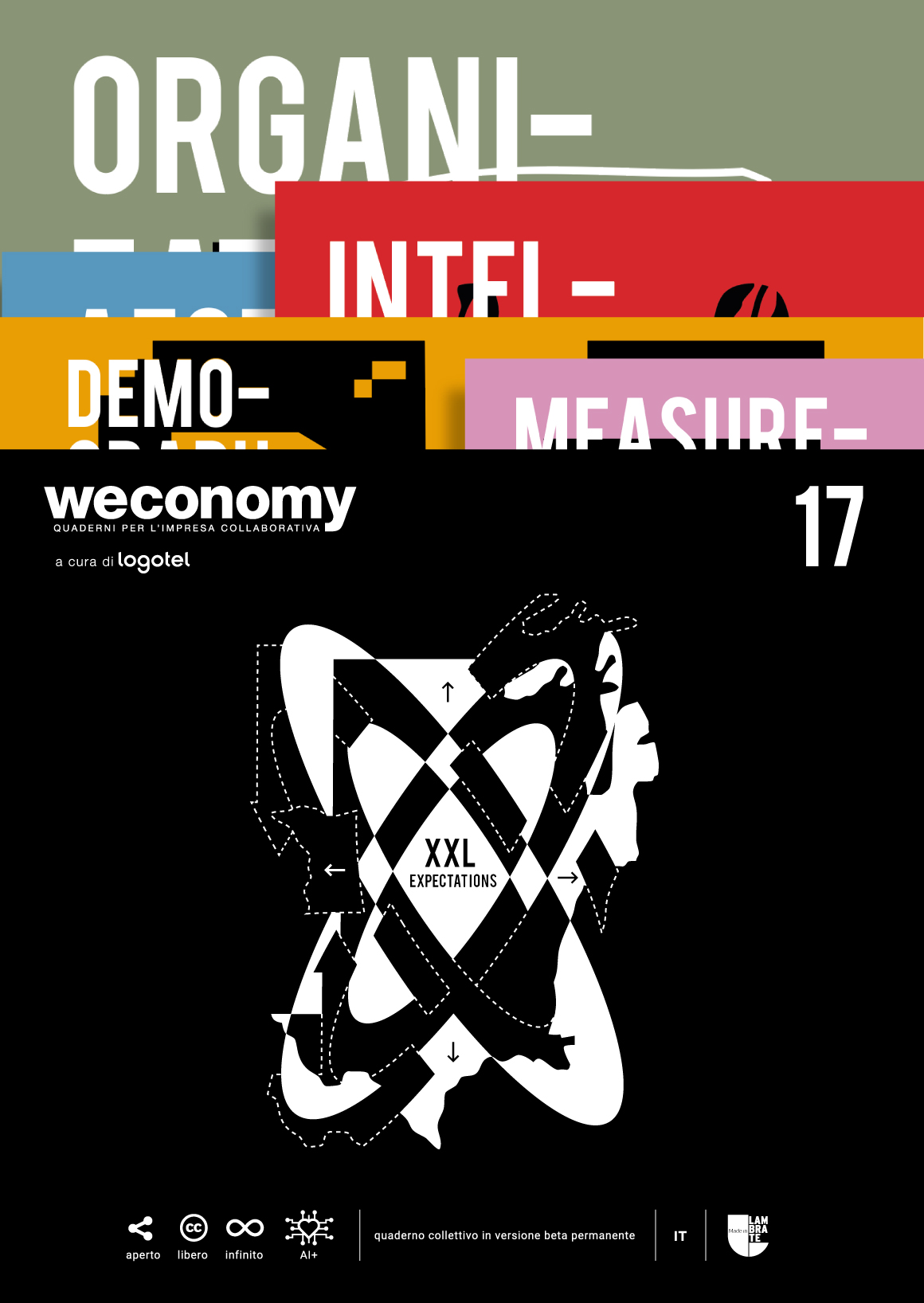
To make this mechanism work, we first need to bring into focus the places where expectations coalesce into new questions. This is why we chose to organise this Weconomy journey into five independent books, each centred on a theme where new questions can begin to take shape.
Demography is the starting point. It is the first territory in which to apply the anti-problem method, but its implications ripple outward everywhere.
From organisations emerges an expectation of new strategies: the context is still read through the lens of VUCA (Volatile, Uncertain, Complex, Ambiguous), but the scenario calls for a new framework – the FLUX model developed by Timothy Tiryaki (Fast, Liquid, Uncharted, eXperimental). Here, the need to experiment becomes essential because it helps orient the future – a space where imagination turns into concrete practice, and leadership is transformed.
From aesthetics emerges an expectation of new creative forms. This is the territory where frugal and original creative paths converge – capable of engaging people and places, and of resisting the homogenisation imposed by major platforms. By exploring new niches, the languages of a post-digital era begin to emerge.
From intelligences emerges an expectation of new ways of working and learning: collaboration between humans and AI is not bent toward the repetition of what already exists, but – through different modes of interaction that still need to be clearly defined – generates a multiplicity of expressive forms, each with its own scope and function.
From measurement emerges an expectation of new metrics: vital indicators that capture relationships between people and the energy generated by collaboration. Indicators that help distinguish – within a flood of numbers and data – value from the mere production of noise.
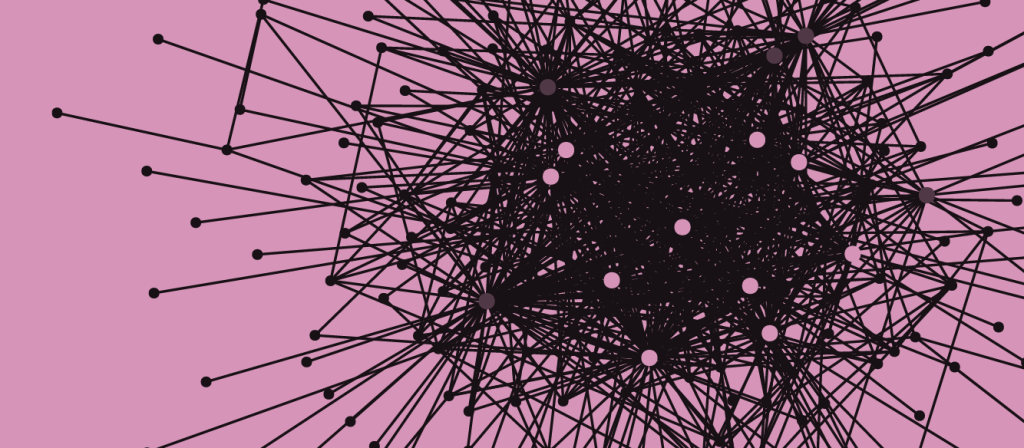
Each territory follows the same path: we look at the facts to provide data and unlock new perspectives; we engage with expectations to shape concrete viewpoints, navigate the present, and activate the future. This is not a linear process but an interconnected ecosystem, where expectations inform and amplify one another. It is within these connections that value can be generated in a fragmented world.
Navigating without denial
Extra-large expectations are the compass for this journey. Anti-problems are the method for bringing new questions to the surface. And cumulative micro-practices are how they take shape in reality, one feedback loop at a time. Because in a fragmented context, we need navigational tools that work within multiplicity – tools that turn uncertainty from paralysis into energy for experimentation.
This is why we chose to place the contributions of the experts featured in this issue of Weconomy alongside a wide range of plural insights drawn from the Logotel ecosystem – as potential experiments capable of activating new project energy. Without reductionism or (new) false promises. And with the aim of making a new horizon practicable.